Le Chéile; Two Peoples, One Struggle, One Kufiya

Some solidarities do not need to be explained. They are recognized.
When Palestinian prisoners in Israel's Nafha prison heard that Bobby Sands had died on May 5th 1981, sixty six days into his hunger strike, they smuggled out a letter. It read: "We salute the heroic struggle of Bobby Sands and his comrades, for they have sacrificed the most valuable possession of any human being. They gave their lives for freedom."
No diplomatic channel. No formal alliance. Just two peoples, separated by an ocean, who understood each other completely.
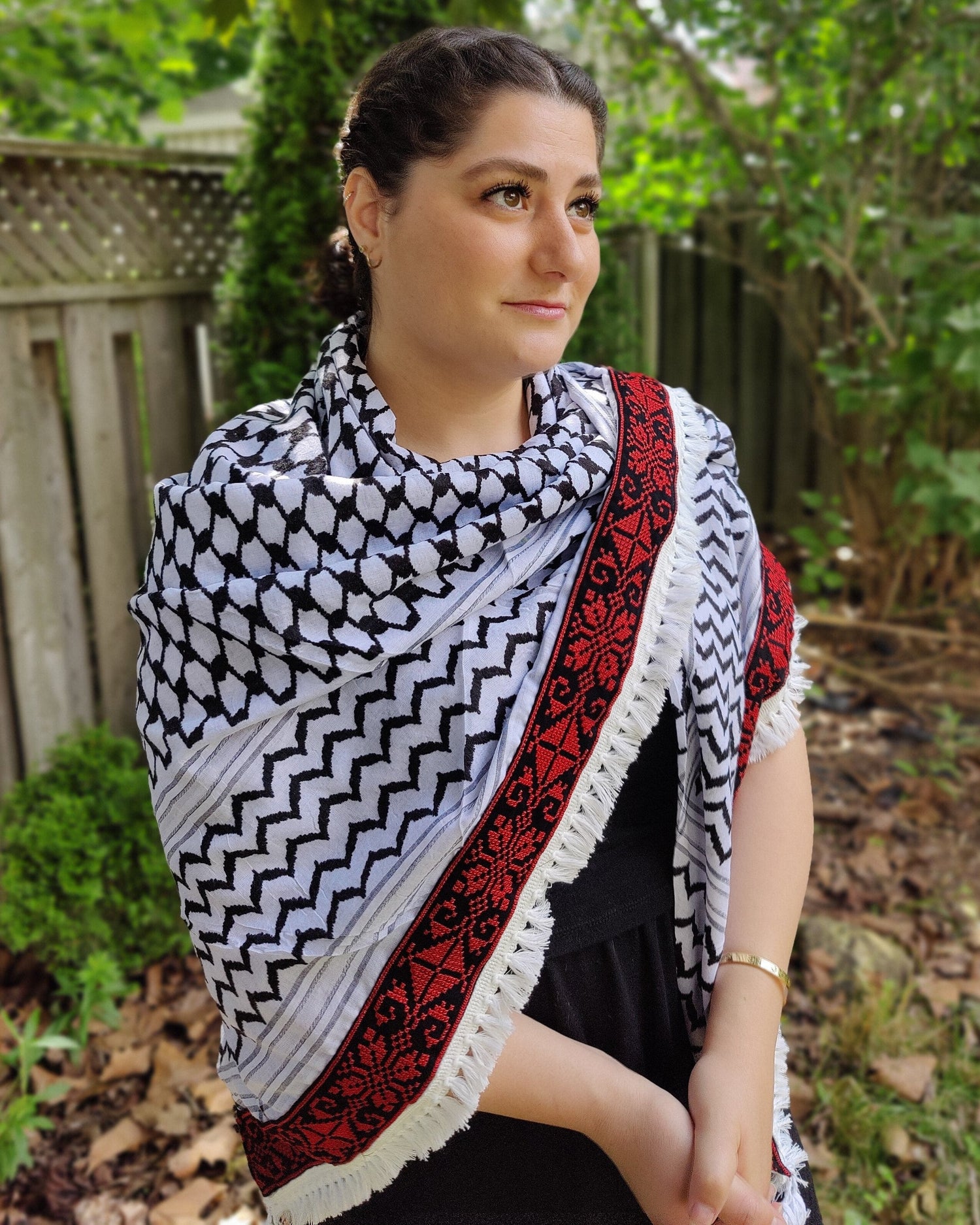
That recognition is what the Le Chéile Kufiya is made of.
The Threads
When The Olive Tree began working with Irish4Palestine Toronto on this kufiya, the first question was not what to make. It was how to make it right.
The Irish tricolor, green, white and gold, had to live inside the kufiya pattern without overwhelming it. Not a flag printed onto fabric. The tricolor woven into the structure of the kufiya itself, thread by thread, the same way the kufiya has always been made in Jordan. The result had to feel inevitable, as if these two symbols had always belonged together.
It took multiple iterations. The thickness of each color band was revised and revisited until the tricolor sat symmetrical, proportional, exact. The final thread shades were confirmed by Irish4Palestine, people who know what those colors mean and would not accept approximation. When it was right, everyone in the room knew.
Palestinian hands, on the oldest kufiya looms still running, wove the Irish tricolor into a Palestinian garment. That is not a detail. That is the entire point.
A Shared Grammar of Resistance
To understand why this kufiya exists, you have to understand what Ireland and Palestine share. Not as a list of parallels, but as a shared grammar of resistance.
The Black and Tans arrived in Ireland in 1920, a paramilitary force deployed by the British government, trained in collective punishment, answerable to no one. They burned towns, shot civilians, terrorized a population. The tactic was not new. It would not be the last time a colonial power used it.
Bobby Sands died in the H-Blocks demanding to be recognized as a political prisoner rather than a criminal. He was not alone. Nine of his comrades followed him in 1981. Palestinian prisoners have hunger struck in Israeli military prisons for decades, against administrative detention, against torture, against a legal system that holds Palestinians under military law while Israeli settlers are tried in civilian courts with a conviction rate that runs to approximately 3 percent. The military courts that try Palestinians, by contrast, carry a conviction rate of 96 percent, based, according to the Israeli human rights group B'Tselem, largely on confessions extracted under duress.
On March 30th 2026, the Israeli Knesset passed a law mandating the death penalty by hanging for Palestinians convicted of killing Israelis in acts classified as terrorism. The law applies through military courts that try Palestinians only. Israeli settlers who kill Palestinians are tried in civilian courts and are explicitly exempt from the law. When the vote passed, members of the Knesset chamber erupted into cheers.
The Irish have seen this before. A legal system designed to protect the colonizer and criminalize the colonized. A people stripped of legal standing on their own land. They have also seen what comes next.
What Survives
The Irish language was suppressed for centuries. Schools were shut, speakers punished, the language itself treated as a threat to colonial order. It survived. Today it is spoken, taught, protected, and woven into the name of this kufiya. Le chéile. Together.
Palestinian Arabic carries within it the names of villages that were destroyed in 1948, places that exist now only in the mouths of the grandchildren of those who fled. Palestinian women embroider the names and symbols of their villages into tatreez, stitch by stitch, so they cannot be erased. Culture as memory. Memory as resistance.
The Olive Tree was built on exactly that instinct. Every kufiya, every tatreez piece, every ceramic from Al Khalil is an act of cultural insistence. We exist. We remember.
Irish4Palestine understands this not as observers but as participants. The solidarity between these two communities is not symbolic. It is organized, marched, advocated, and now woven.
Le Chéile
Ireland is a republic today. It took centuries of occupation, famine, criminalization and resistance to get there. The generation that fought for Irish independence did not always live to see it. They fought anyway.
Palestine will be free. The kufiya will still be woven when it is.
Ní neart go cur le chéile. We are stronger together.
Irish4Palestine-Toronto - Instagram
Le Chéile Collaboration Video - Instagram
References
- Bobby Sands, death on hunger strike, May 5th 1981. An Phoblacht. Link
- B'Tselem, Israeli military court conviction rates and administrative detention. B'Tselem press release, March 30 2026. Link
- Human Rights Watch, Israel: Discriminatory Death Penalty Bill Passes, March 31 2026. Link
- Al Jazeera, What is Israel's death penalty law that only applies to Palestinians? April 1 2026. Link