Nakba Day: What It Means and Why Palestinians Commemorate It

Every year on May 15, Palestinians commemorate Nakba Day.
The word Nakba means catastrophe in Arabic. It refers to the mass displacement and dispossession of Palestinians in 1948, when hundreds of thousands of Palestinians were forced from their homes and became refugees. The United Nations describes the Nakba as the mass displacement and dispossession of Palestinians during the 1948 war.
For Palestinians, Nakba Day is not only about remembering a historical event. It is about recognizing a continuing reality of exile, occupation, displacement, and the unresolved right of return.
What happened during the Nakba?
Before the Nakba, Palestine was home to Palestinian towns, villages, farms, schools, markets, mosques, churches, and family life rooted across generations.
In 1948, Zionist militias and later Israeli forces displaced hundreds of thousands of Palestinians from their homes through military assault, massacres, forced expulsions, fear, and the destruction or depopulation of Palestinian towns and villages.
Many Palestinians left believing they would return within days or weeks. Instead, they became refugees, and generations of Palestinians have since been born in exile.
Families carried what they could: house keys, land documents, photographs, clothing, textiles, and memories of the places they were forced to leave.
Those objects became more than belongings. They became proof of presence. The key became one of the clearest symbols of the Palestinian right of return.
Massacres and forced expulsions during the Nakba
The Nakba should not be reduced to vague language like “migration” or “conflict.”
It included massacres, forced expulsions, village destruction, and organized dispossession carried out by Zionist militias and later Israeli forces to remove Palestinians from their homes, towns, and villages.
One of the most widely documented examples is the Dayr Yasin massacre on April 9, 1948. Palestinian civilians were killed in the village of Dayr Yasin, and the massacre became one of the defining events of the Nakba. Its impact spread far beyond the village itself, creating fear among surrounding Palestinian communities already facing military assault and expulsion.
Mass expulsions were also central to 1948. In July 1948, Palestinians were expelled from al-Lydd and al-Ramla during Operation Dani. Families were forced to leave on foot in extreme summer heat, and many were never allowed to return.
Other massacres, including al-Dawayima, are also part of the historical record of the Nakba.
Naming these events matters.
Palestinians were not simply people who “left.” Many were forced out through massacres, fear, military operations, and the destruction of their towns and villages. The language used to describe the Nakba must reflect that reality.
Why does Nakba Day still matter?
Nakba Day matters because the effects of 1948 did not end in 1948.
Millions of Palestinians remain refugees or descendants of refugees. Many are still denied the right to return to their ancestral homes. Palestinian communities continue to experience displacement, movement restrictions, land confiscation, settlement expansion, home demolitions, and the fragmentation of daily life under occupation.
For this reason, Palestinians often describe the Nakba as ongoing.
It is not only a past catastrophe. It is a living condition shaped by displacement, memory, and the continued denial of return.

Memory as a form of continuity
Palestinian memory has survived through more than written history.
It lives in family stories, embroidered patterns, recipes, songs, village names, religious traditions, and cultural symbols passed from one generation to the next.
Tatreez embroidery is one example. Traditionally stitched by Palestinian women, tatreez carries regional patterns, family memory, and visual identity. Each motif connects Palestinian craft to place, history, and continuity.
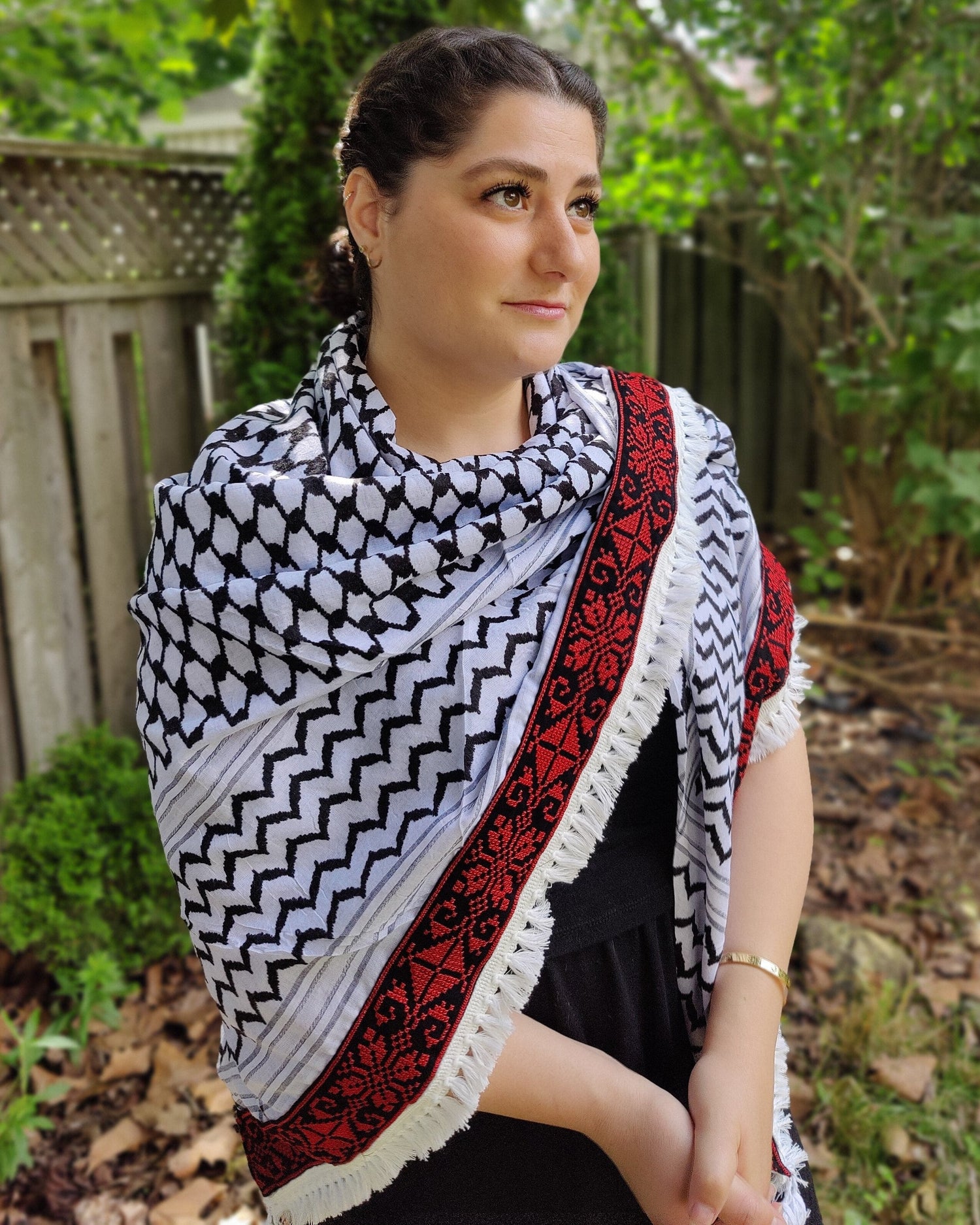
The kufiya is another. Worn across generations, it has become one of the most recognized symbols of Palestinian identity. Its presence carries memory, belonging, and refusal.
These cultural forms are not separate from history. They are ways Palestinians continue to hold on to identity despite displacement.
The right of return
One of the central issues connected to Nakba Day is the Palestinian right of return.
For Palestinians, return is not only symbolic. It is tied to homes, villages, land, family history, and legal rights. It remains one of the most important and deeply felt parts of the Palestinian struggle.
Nakba Day keeps this right visible.
It reminds the world that displacement is not resolved by time. A people do not lose their connection to land because decades have passed. Memory does not expire. Rights do not disappear because they are denied.
Why The Olive Tree commemorates Nakba Day
At The Olive Tree, Palestinian heritage is not decoration. It is connected to identity, memory, and continuity.
A kufiya is not only fabric.
Tatreez is not only embroidery.
Ceramic, thread, wood, and textile all carry traces of place, craft, and survival.
To commemorate Nakba Day is to honor the families who carried Palestine through exile, the villages whose names were meant to be erased, and the generations who continue to preserve Palestinian identity with clarity and pride.
Nakba Day is a day of grief, but it is also a day of truth.
It asks us to remember what happened.
It asks us to name the massacres and expulsions.
It asks us to recognize what continues.
It asks us to understand why return remains central to Palestinian life.
Palestine is not only remembered in the past.
It is carried in the present.
And it remains rooted in the future.